
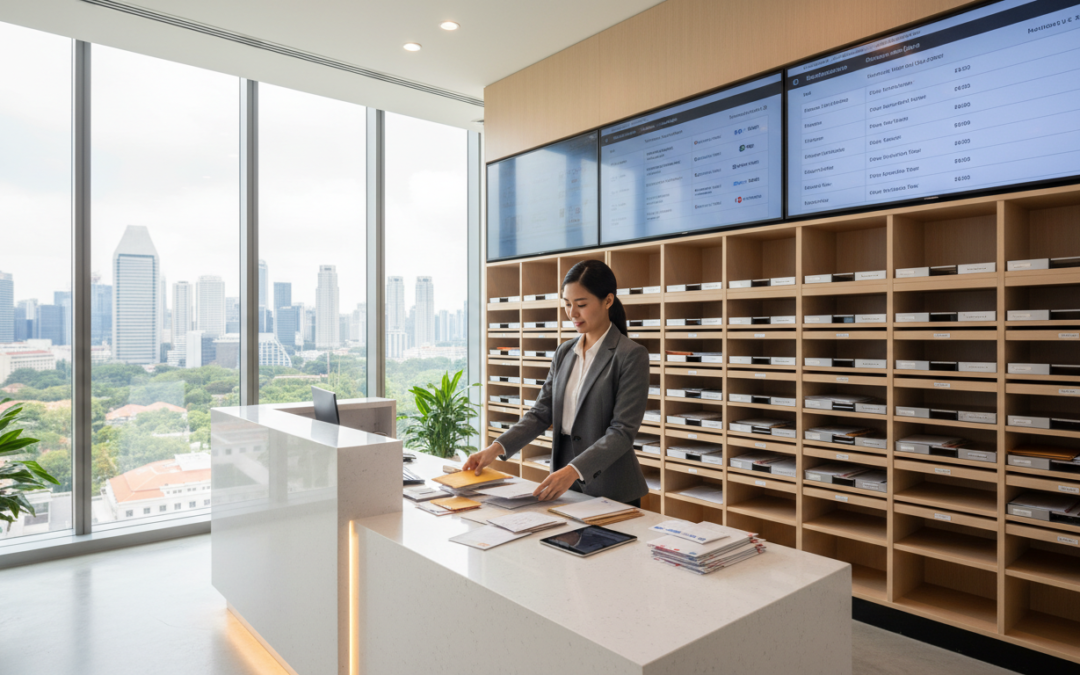
Just after landing in the city, a founder received a stack of important letters at a rented address and sighed with relief. He had no desk, no receptionist, but the mail kept his launch on track.
This page explains a corporate mailroom setup built for a virtual office in Singapore that keeps business mail organised, secure and actionable without a physical base.
Providers such as Servcorp describe the model as “everything but the office”, pairing a credible address with mail handling and optional phone support. Others advertise weekly forwarding, unlimited scanning or optional call management in the CBD.
The commercial promise is simple: a clear workflow to receive, log, notify, scan, forward or hold post so remote founders and distributed teams can focus on growth.
Read on to learn what is typically included, how the workflow operates, address and ACRA considerations, location choices from CBD to city-fringe, add-ons like meeting rooms, and typical pricing in SGD.
Note: Features such as global networks, IT support and flyer sorting vary by provider and should be confirmed before purchase.
Key Takeaways
- A tailored mail handling workflow supports remote teams and founders.
- Top providers frame the offering as a full business presence without a physical workspace.
- Expect core actions: receive, log, notify, scan, forward or hold.
- Location, add-ons and pricing vary; check address rules and ACRA guidance.
- Verify provider-specific features like global forwarding and call handling.
Corporate mailroom support built into your virtual office
Many providers now bundle a reputable address with reception, mail handling and phone options so a company can maintain a credible presence without leasing a full workspace. This model suits firms that need a professional front while their teams work remotely.
Who this service is for in Singapore
Start-ups that prefer not to list a home address, SMEs that demand reliable handling of letters and parcels, and foreign businesses setting up a local footprint benefit most. The arrangement reduces missed deliveries and speeds response to time-sensitive documents.
What “everything but the office” means in practice
Everything but the office means you work anywhere while a staffed location receives mail, answers calls and projects front-of-house professionalism. It is not a physical office by default; it keeps administrative essentials in place and lowers overheads.
- Flexible collection: self-collection for local operators.
- Digital-first: scanning for frequent travellers.
- Forwarding: for teams based outside the city.
virtual office singapore corporate mailroom service: what’s included
Smart packages bundle reception, digital handling and optional call support so founders can act fast.
Secure reception: Providers accept letters, parcels and courier deliveries at a staffed address. Items are logged and stored under controlled access until you instruct otherwise.
Notifications and tracking: Prompt alerts arrive by email or via a user portal. The portal often separates business mail from marketing flyers to save sorting time.
Self-collection: Local teams can pick up items at convenient times near MRT stations. This reduces failed re-deliveries and saves on forwarding fees.
Weekly forwarding: Plans commonly include weekly forwarding options (some allow up to 2kg). Forwarding schedules suit remote teams who want predictable postage cycles.
Unlimited scanning: Selected plans offer unlimited scanning to searchable PDF, creating a digital filing system that supports quick search and archiving.
Optional phone handling: Some providers add a local line and receptionist who answer in your company name and route calls per your instructions.
Facility tie-ins: Many operators also sell meeting and day-room access so you can host clients when needed.
Professional business address and registered office address in Singapore
A professional business address helps you look established to clients while a separate registered office handles formal notices and statutory mail.
Use your public address on your website, proposals, invoices and business cards to present a stable footprint. Listing a clear office address on client documents builds trust and reduces confusion when deliveries arrive.
Registered address and ACRA considerations
The registered office must accept official correspondence from regulators. Many providers note that a recognised street location is generally accepted by ACRA for company registration.
“Some plans include a Free Contact Address for ACRA, which can simplify setup for local companies.”
Why a street address beats a P.O. Box
- Credibility: A street address looks more trustworthy on proposals and maps.
- Compliance: ACRA and couriers favour a physical address over a P.O. Box for formal delivery.
- Practicality: Use the address for registration, correspondence and Google map pins — but confirm permitted uses first.
Quick reminder: confirm what you may list publicly and keep your registered address records updated to avoid missed notices.
Singapore CBD and city-fringe locations that strengthen credibility
An address in the Central Business District often signals stability and scale to prospective customers. Choosing a prominent location supports trust with banks, partners and enterprise clients.
Downtown Core options include well-known towers such as Ocean Financial Centre (10 Collyer Quay), Singapore Land Tower (50 Raffles Place), Frasers Tower (182 Cecil Street), One Raffles Quay and Marina Bay Financial Centre. These locations add visible prestige to your office address and make introductions easier.
City-fringe practicality matters too. Paya Lebar Square is MRT-accessible and suits teams that prefer routine, local pick-up over daily travel to the CBD. It is a sensible location for parcel-heavy operations and staff who collect mail.
Some premium virtual office networks advertise access to 150+ locations worldwide, offering meeting rooms and lounge space for travelling executives. Pick a location that matches your brand, proximity needs and courier access to keep operations smooth.
How our mail handling process works day-to-day
A clear, repeatable intake process keeps incoming post traceable and reduces disputes.
Receiving and logging incoming mail
Staff receive items, record sender, date and type, and store everything securely. This creates an audit trail that lowers the risk of lost or disputed items.
Sorting: business mail vs marketing flyers
Where the portal supports it, items flagged as marketing are separated from genuine business correspondence.
This helps teams focus quickly on what matters and reduces unnecessary handling.
Scan, forward, or hold — your instructions, executed
Customers choose a standard path: scan to PDF, request forwarding, or hold for collection. The team follows those instructions every time.
Services are logged and executed consistently to match your operational needs.
Turnaround times, business hours and cut-offs
Expect actions to align with staffed hours (typical example: Mon–Fri 08:30–17:30) and courier schedules.
Forwarding and scanning depend on daily cut-offs and may vary by courier or peak month demand.
Notifications arrive by email or via the portal so your team can respond without delay.
Operational consistency ensures the same routine holds during busy periods or staff changes, giving remote leaders confidence their mail is handled to plan.
Mail forwarding, scanning and parcel handling options
Many businesses pick a mixed approach — digital scans for day-to-day letters and physical forwarding for originals that must travel.
Weekly forwarding plans commonly consolidate items, package them securely and dispatch on a set day. Some plans include FREE weekly mail forwarding up to 2kg which keeps predictable postage cycles and reduces ad‑hoc courier fees for a company that receives infrequent originals.
Digital workflows for frequent travellers
Where available, the team scans incoming post to searchable PDF and routes it by email for approval or filing. FREE Unlimited mail scanning to searchable pdf options turn paper into searchable records and let remote teams act fast without waiting for parcels.
Secure handling of parcels and couriers
Couriers are accepted, signed for and stored under controlled access until the authorised person collects or instructs forwarding. This prevents mis‑collection and keeps larger packages safe while you decide the next step.
Cost levers matter: forwarding fees, weight thresholds and packaging determine total cost in SGD. Choosing scanning over forwarding often reduces postage spend if originals are not required.
Decision guide: pick forwarding when originals or regulatory documents must move physically. Choose scanning when speed, low cost and remote approvals matter most. For mixed needs, combine both and set clear rules in your portal or instructions.
For a practical plan that balances scans and dispatch, consider a dedicated mail forwarding package from a recognised provider like VOffice mail forwarding.
Add-on workplace access: meeting rooms, day offices and coworking
Occasional access to professional space lets remote teams host important discussions without a long lease. Short bookings keep your brand consistent and let you meet partners or clients in a controlled setting.
Meeting rooms and boardrooms for client-facing appointments
Meeting rooms and boardrooms are bookable by the hour and often include reception support and AV for presentations or video calls. Providers such as Servcorp cite coworking lounge access of 3 hours/day on some tiers, while TEC offers member rates for room hire.
Coworking lounge access measured in hours
Coworking access is commonly measured in hours per day or per month. Plans vary, so match usage to your pattern — some tiers offer 60 hours/month (3 hours/day) while others use pay‑as‑you‑use pricing.
Private day-office access for focused bursts
Day offices provide a private room for a productive day, interviews or for travelling executives. This short-term office space helps when home working is impractical.
- Book via app or portal, where available; check if hours roll over.
- Confirm member rates, guest reception and booking windows in your virtual office package or office package.
Combine a strong address with occasional physical space to maintain credibility and give clients a consistent, professional experience when it matters.
Plans and pricing in SGD: choose the right virtual office package
Pick a plan that matches how often you need originals, how fast you need alerts, and whether receptionist support matters.
Budget entry: From around S$50/month you can get a virtual office address with basic mail handling and self-collection. For example, a fringe location such as Paya Lebar Square offers a S$50/month self-collection plan and S$100/month plans for forwarding or scanning.
Mid-tier benchmark: Most addresses sit between SGD $50–$160/month. These tiers usually add regular scanning, limited forwarding allowances and portal access for notifications and item history.
Premium options: Higher tiers unlock receptionist answer, meeting-room credits and higher forwarding weights. Examples include SGD128, SGD220 and SGD600 plans from established providers. TEC, with a 12-month commitment, lists Business Address from SGD99/month, Premium at SGD162/month and select locations from SGD180/month.
“Compare inclusions — mail volume, scan limits, forwarding weight, phone handling and meeting access — not just headline cost.”
| Tier | Typical price (SGD/month) | Common inclusions |
|---|---|---|
| Entry | S$50–S$80 | Address listing, self-collection, basic notifications |
| Mid | S$90–S$160 | Unlimited scanning (select plans), scheduled forwarding, portal access |
| Premium | S$128–S$600 | Receptionist calls, meeting-room credits, higher forwarding limits |
Selection checklist:
- How often do you need originals sent? If rare, favour scanning.
- Do you need receptionist support or international access?
- Does the office address and portal give quick notifications and tracking?
Why businesses choose a virtual office mailroom service in Singapore
A handled address and intake system lets a small team act larger without the usual overheads.
Reduce overheads versus a physical office while maintaining presence
Lower start-up cost and monthly rent are the most obvious gains. Companies skip long leases yet keep a credible business presence for clients, banks and suppliers.
Support teams without hiring: reception, secretarial and IT assistance
The operational benefit is clear: fewer admin distractions because staff log, notify and process post as a managed service.
Optional add-ons include receptionist answer, secretarial help and IT support. These options let a small company operate like a larger firm without extra hires.
Month-to-month flexibility and fast set-up in minutes
Some providers offer sign-up in under five minutes and month-by-month billing. This speed and flexibility suit teams that need to scale or pivot quickly.
- Reputational upside: a recognised building and professional handling improves client perception.
- Operational clarity: consistent logging and alerts save time and reduce missed deadlines.
- Global reach: networks with offices across the world help teams maintain consistent standards when operating across regions.
For more detail on options and support levels see about us.
Trust, security and service standards you should expect
Trust grows when you can inspect storage, test the phone line and meet the front‑desk team in person.
Secure storage, controlled access and confidentiality
Secure storage: expect locked cabinets, CCTV and a clear retention policy for sensitive mail and legal documents.
Controlled access: ask who has keys and how access is logged. Confidential handling must be written into terms.
Transparent checks: phone, reception and IT
Before you commit, request a number to test the phone line and listen for professional answer tones and correct company name routing.
Meet reception staff where possible and confirm whether IT support is in‑house or third party. Verify secure Wi‑Fi with unique passwords.
Customer experience signals
Look for fast replies by email or messaging, MRT‑adjacent collection points and consistent scan/forward turnaround times.
“Meet, test and try” — Servcorp
| Check | Why it matters | What to ask |
|---|---|---|
| Storage & access | Protects sensitive documents | Locked areas, access logs, CCTV |
| Phone line | Client impressions and routing | Test number, voicemail routing, mobile forwarding |
| IT & network | Data privacy and uptime | On‑site support? Secure Wi‑Fi? Backup policies? |
Conclusion
A credible address plus dependable mail handling can keep a small team responsive without a full lease.
Choose a business address and mail workflow that match how you work. A clear virtual office address and an easy-to-use portal reduce delays and disputes.
Compare location options — CBD prestige versus fringe convenience — and weigh mail forwarding limits, scanning availability and portal quality when you decide. Check meeting-room access if you host clients in person.
Market examples: entry plans start at about S$50 with self-collection (VOffice), mid tiers sit around S$50–S$160, and premium providers such as Servcorp and TEC add broader access and support.
Review packages, confirm cut-offs and inclusions, and pick a plan that scales. If you need originals, favour forwarding and parcel handling; if you travel, favour scanning and fast notifications. For a final step, contact providers to compare costs and sign-up terms for your singapore virtual presence and office address as required.
FAQ
Who is this corporate mailroom support aimed at?
What does “everything but the office” mean in practice?
What is included in secure mail reception for letters, parcels and courier deliveries?
How will I be informed about new mail and parcels?
Can I collect mail in person?
How do weekly mail forwarding plans work?
Is unlimited mail scanning offered?
Can I add phone handling with dedicated receptionists?
May I use the address on my website and client documents?
What should I consider for ACRA registered addresses?
Why is a street address preferable to a P.O. Box for business use?
Which city and fringe locations enhance business credibility?
Do providers offer multi‑location networks and international addresses?
How is incoming mail handled day‑to‑day?
What are typical turnaround times and cut‑offs for forwarding?
What forwarding, scanning and parcel options exist?
How are couriers and package deliveries managed securely?
Can I book meeting rooms, day offices or coworking space as add‑ons?
What pricing tiers should I expect in SGD?
How does this solution reduce overheads compared with renting a physical premises?
What support can I expect without hiring in‑house staff?
Are there flexible commitment options?
What trust and security standards should I demand?
How can I judge customer experience signals?

Based in Singapore, Dean Cheong is a B2B growth consultant and CEO of VOffice who works with companies to unlock revenue through smarter sales processes and data-driven CRM adoption. Drawing on his finance training at Nanyang Technological University and years of hands-on leadership, he builds sustainable growth engines that turn strategy into measurable results.